Beekeeping in INDIA

Bees, honey and beekeeping have been mentioned in various Hindu Vedic scriptures of India like Rig Veda, Atharva Veda, Upanishads, Bhagavad Gita, Markandeya Purana, Raj Nighantu, Bharat Samhita, Arthashastra, and Amar Kosha. Various Buddhist scriptures likeVinaya Pitaka, Abhidhamma Pitaka and Jataka tales also mention bees and honey. Vatsayana's Kamasutra mentiones honey to play significant factor in sexual pleasures. The popular epic Ramayana describes a "Madhuban" (literally honey forest) that was cultivated bySugriva. A different Madhuban is also mentioned in the epic Mahabharata near the present day Mathura where Krishna and Radha used to meet. The forest was used to tame bees to make India "land of honey and milk"
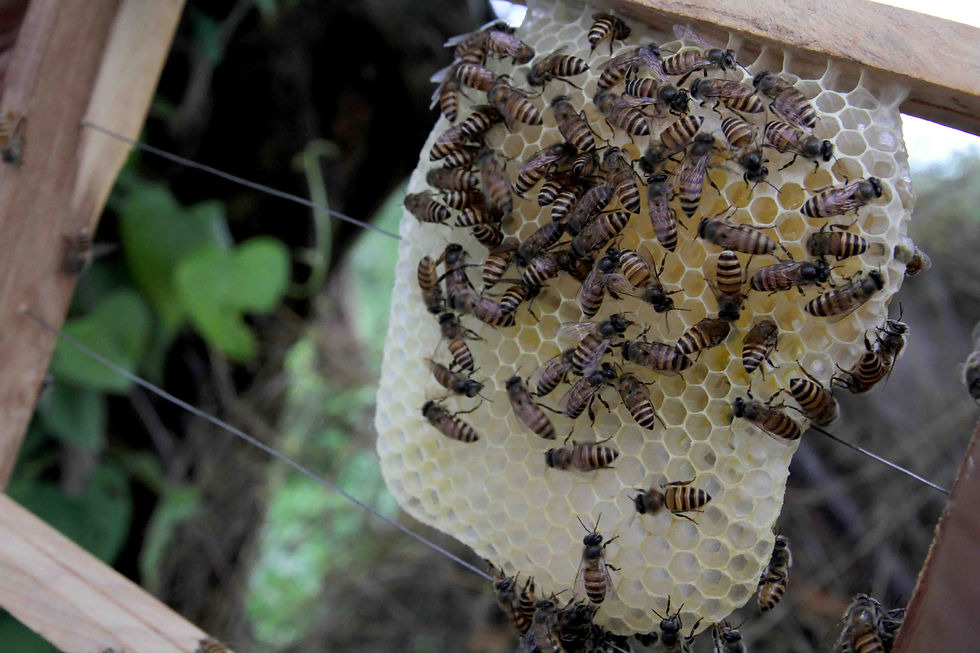
The establishment of Khadi and Village Industries Commission to revitalize the traditional village industries, hastened the development of beekeeping. During the 1980s, an estimated one million bee hives had been functioning under various schemes of the Khadi and Village Industries Commission. Production of apiary honey in the country reached 10,000 tons, valued at about Rs. 300 million. Side by side with the development of apiculture using the indigenous bee, Apis cerana, apiculture using the European bee, Apis mellifera, gained popularity in Jammu & Kashmir, Punjab, Himachal Pradesh, Haryana, Uttar Pradesh, Bihar and West Bengal. Wild honey bee colonies of the giant honey bee and the oriental hive bee have also been exploited for the collection of honey. Tribal populations and forest dwellers in several parts of India have a honey collection from wild honey bee nests as their traditional profession. The methods of collection of honey and beeswax from these nests have changed only slightly over the millennia. The major regions for the production of this honey are the forests and farms along the sub-Himalayan tracts and adjacent foothills, tropical forest and cultivated vegetation in Rajasthan, Uttar Pradesh, Madhya Pradesh, Maharashtra and the Eastern Ghats in Orissa and Andhra Pradesh.
About 10,000 tons of forest honey are produced annually. Forest honey, mostly from rock bee hives, is usually collected by tribals in forests and is procured by forest or tribal corporations as a minor forest produce. Quite a large quantity is also collected by groups or individuals on their own. Forest honey is usually thin, contains a large quantity of pollen, bee juices and parts, wax and soil particles. Forest honey is mostly multi floral.
Apiary honey is usually multi floral when marketed by state-level marketing organizations because honey from different sources is mixed while pooling, storage, and processing. Several uni-floral honey is available in markets restricted to small areas within the state where it is produced. Rubber plant contributed to over 60 per cent of the total apiary honey production during 1990-91. Besides this, jamun, hirda, beheda, arjun, neem, litchi, palmyrah palm, eucalyptus, lagerstroemias, tamarind, cashew tree, scheffleras, tun, karanj, false acacia, wild shrubs like shain, crops of different varieties of mustards, sesame, niger, sunflower, berseem clover, khesari, coriander, orchard trees including different types of citrus, apple, podium, cherry and other temperate fruit trees, coconut tree and coffee plantations are some important sources that provide uni-floral honey.
Much of the forest honey is sold to the pharmaceutical, confectionery and food industries, where it is processed and used in different formulations. Apiary honey is usually processed at the producers level. This consists mainly of heating the honey and filtering. A few beekeepers or honey producers co-operative societies have better processing facilities that involve killing off honey fermenting yeasts. About 50 percent of the apiary honey under the KVI sector is graded and marketed under AGMARK specifications. In 1985 the consumption of honey was estimated to be about 8.4 g per capita, while in other countries this was 200 g. Presently this would be about 2.5 g. Honey has so far been consumed mainly as a medicine and for religious purposes. A small quantity has been used in the kitchen as an ingredient of pickles, jams, and preserves. With the increasing production in recent years, there is an increasing trend to use honey in food. This is obviously the case with the affluent segments of the population. Forest honey is used in pharmaceutical, food, confectionery, bakery and cosmetic industries. One often finds a good demand for local honey like honey from Mahabaleshwar. People in Maharashtra have a strong liking for jamun, hirda or gela honeys which have acquired special individual medicinal significance. Similarly, kartiki honey in Kumaon, Uttar Pradesh is locally much favored. Some honey has an essentially non-local market. Rubber tree honey can only be sold in non-local markets. Coorg honey with its characteristic flavor was well-known during the 1950s and 1960s. Shain or sulah honey from Kashmir has been very popular. Presently litchi honey from Bihar and other northern states is in great demand. The price structure is regulated by the market forces of supply and demand. Beekeepers in well-known hill stations and other places of tourist attraction take advantage of the popularity of honey and can market their produce at remunerative prices. Indian honey has a good export market. With the use of the modern collection, storage, beekeeping equipment, honey processing plants and bottling technologies the potential export market can be tapped.



Comments